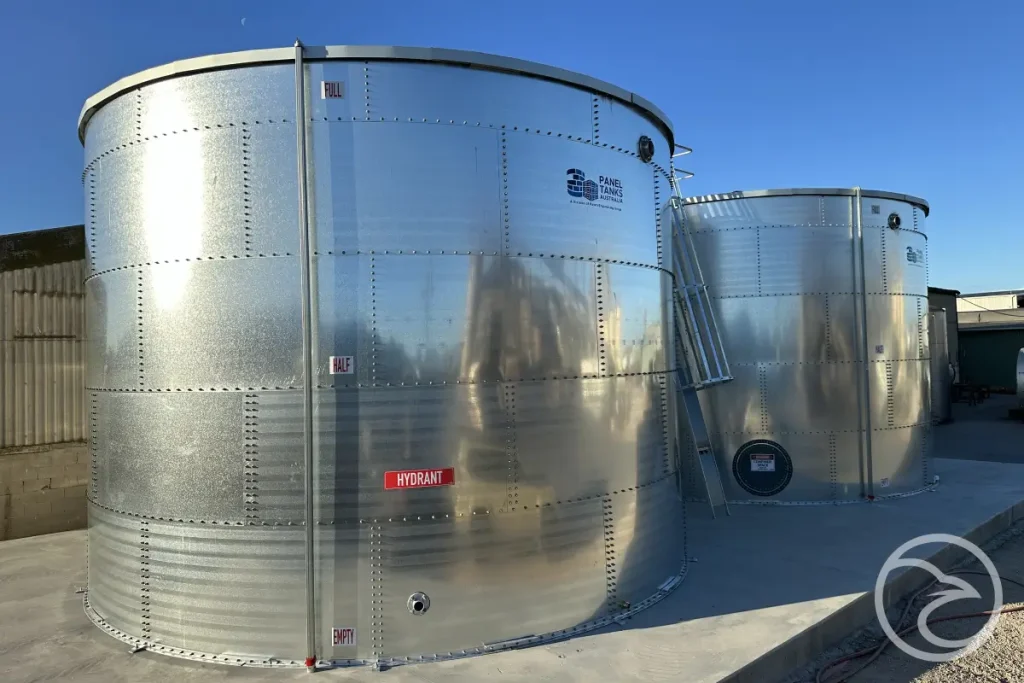
Large water storage systems play a critical role across many industrial, commercial, and municipal operations. Their performance directly affects production reliability, fire protection readiness, environmental management, and water security. When designing or evaluating these systems, structural stability water systems becomes one of the most important considerations. A stable structure ensures long-term operation, safety, and resilience under a wide range of internal and external stresses.
Understanding why structural stability matters helps organisations make informed decisions when selecting materials, assessing design options, and planning long-term maintenance strategies.
Why Structural Stability Matters in Large Water Storage Systems
Structural stability refers to a tank’s ability to maintain its shape, integrity, and load-bearing capacity under various physical and environmental pressures. Large water tanks, whether steel, concrete, FRP, or modular panel designs, face continuous forces from stored water, temperature variations, vibration, wind, and site conditions.
Even minor weaknesses can lead to:
- deformation of tank walls
- accelerated wear or corrosion
- leakage or seepage
- collapse under extreme stress
- costly system downtime
- serious safety hazards
A stable system protects both the stored water and the surrounding environment, reducing the risk of catastrophic failure.
1. Internal Water Pressure and Structural Load
The most obvious and constant force acting on a water tank is hydrostatic pressure—the force exerted by the stored water. The taller the tank and the larger the volume, the greater the pressure on the base and walls.
Large storage systems must be engineered to withstand:
- vertical loads from water weight
- outward pressure against tank walls
- dynamic stress from inflow and outflow
- pressure fluctuations caused by temperature changes
If the tank’s structural design does not account for these forces, instability may develop over time, leading to buckling, cracks, or seam separation.
2. Material Strength and Compatibility
Different materials offer distinct structural advantages and challenges. The stability of a large water storage system depends heavily on selecting a material suitable for both operating conditions and environmental exposure.
Concrete
Known for long-term durability but vulnerable to cracking if exposed to ground movement or freeze–thaw cycles.
Steel
Strong and versatile, but requires proper corrosion protection to maintain long-term stability.
Fiberglass Reinforced Plastic (FRP)
Lightweight and corrosion-resistant, ideal for chemically complex environments.
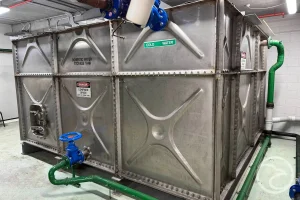
Modular Panel Systems
Allow flexible installation and scalability but must be assembled with precision to maintain structural integrity.
A mismatch between material properties and site conditions can compromise stability over time.
3. Environmental Forces and Site Conditions
Large tanks must endure more than internal pressure. External conditions can heavily influence structural performance, especially in regions with extreme climates or challenging soil profiles.
Key environmental factors include:
- wind loads, especially for tall or elevated tanks
- seismic activity, requiring specific reinforcement
- soil conditions, affecting settlement and foundation stability
- temperature fluctuations, creating expansion and contraction cycles
- exposure to UV radiation, which may weaken some materials
Proper geotechnical analysis ensures that the foundation and anchoring systems provide adequate long-term support.
4. Foundation Design and Settlement Control
The stability of any structure begins with the foundation. Large water storage systems require foundations that can support significant weight while preventing differential settlement.
Important considerations include:
- soil compaction levels
- drainage and moisture control
- load distribution across the tank base
- prevention of uneven settling that can deform tank walls
Poor foundation design is one of the most common causes of structural failures in large water storage installations.
5. Structural Reinforcement and Bracing
Depending on the tank design, additional reinforcement may be required to ensure stability under both static and dynamic conditions.
Examples include:
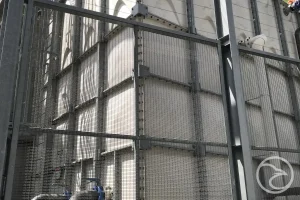
- steel stiffeners
- internal bracing
- external supports
- reinforced joints
- thickened walls or bases
These elements help resist water pressure, wind load, vibration, and seismic activity. Reinforcements must be incorporated early in the design process to ensure efficient load distribution.
6. Thermal Effects and Expansion Behaviour
Temperature fluctuations cause materials to expand and contract. In large tanks, even minor movements can accumulate stress at critical points, such as joints or connection seams.
To maintain structural stability water systems, designers must plan for:
- insulation in extreme climates
- expansion joints
- temperature-resistant coatings
- material selection based on thermal behaviour
Failing to account for thermal cycles increases the risk of cracking, warping, or premature wear.

7. Long-Term Maintenance and Monitoring
Even a perfectly designed tank requires ongoing monitoring to ensure its long-term structural performance. Preventative inspections help identify early signs of instability such as:
- wall deformation
- seam or joint stress
- foundation settlement
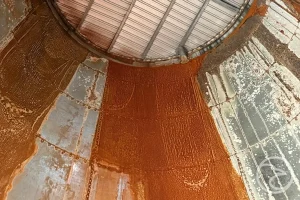
- corrosion or coating damage
- vibration issues from pumps or inflow turbulence
Routine maintenance helps prevent minor issues from evolving into structural failures. Topics related to long-term structural performance are closely linked to ongoing tank care, which supports system reliability over time.
More structural and performance-related considerations are explored in additional notes, offering broader context for long-term system planning.
Conclusion
Structural stability is the foundation of any reliable large water storage system. Whether used for industrial processing, fire protection, potable water supply, or environmental management, robust construction ensures safety, efficiency, and operational continuity. By carefully evaluating internal forces, environmental pressures, material properties, foundation design, and long-term maintenance needs, organisations can create water storage systems capable of performing reliably for decades.
A well-designed structure not only protects stored water but also supports the resilience and sustainability of the entire facility.