Safe storage of industrial chemicals is essential for maintaining operational safety and protecting infrastructure. Many facilities store liquids that can be corrosive, reactive, or environmentally hazardous, which means storage systems must be carefully designed to prevent leaks, contamination, and structural damage.
For this reason, industries often rely on specialised storage systems such as GRP chemical storage tanks. These tanks provide a durable and corrosion-resistant solution for storing a wide range of industrial liquids.
In this article, we explore how GRP tanks support safe chemical storage and why they are commonly used in industrial environments.
Why Safe Chemical Storage is Critical
Chemical storage is a key part of many industrial operations. Facilities such as water treatment plants, manufacturing sites, and processing facilities often handle substances that must be stored safely for long periods.
Improper storage can lead to several risks, including:
- corrosion of tank materials
- chemical leaks and environmental contamination
- structural damage to storage systems
- safety hazards for workers and surrounding infrastructure
Because of these risks, chemical storage tanks must be constructed from materials capable of resisting chemical reactions and environmental stress. This is where composite materials such as GRP offer important advantages.
Many industries rely on GRP tanks because their corrosion resistance makes them suitable for storing a wide range of industrial liquids.
What are GRP Chemical Storage Tanks?
GRP chemical storage tanks are manufactured using Glass Reinforced Plastic, a composite material created by combining resin with reinforced glass fibres. This material produces a strong, lightweight structure that performs well in demanding industrial environments.
Unlike traditional metal tanks, GRP tanks do not rust or degrade when exposed to moisture or many chemical substances. The material is designed to resist corrosion while maintaining structural integrity over time.
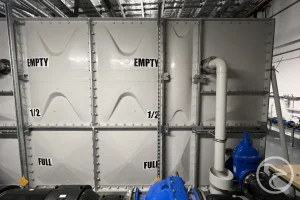
Another advantage of GRP tanks is their modular construction. Many systems are assembled using panel sections that can be transported and installed on site. This allows facilities to build storage tanks that match their required capacity without major construction work.
Because of these characteristics, GRP tanks are widely used for storing liquids in industries where corrosion resistance and long-term durability are essential.
Why GRP is Suitable for Chemical Storage
One of the main reasons industries use GRP tanks for chemical storage is the material’s natural resistance to corrosion. Many industrial chemicals can damage traditional metal tanks over time, especially when exposure occurs continuously.
GRP materials are designed to resist many corrosive environments, making them suitable for storing substances such as acids, alkalis, and industrial process liquids. This resistance helps extend the lifespan of the tank and reduces the need for frequent maintenance.
Another benefit is the structural stability of GRP materials. Reinforced glass fibres provide strength while the resin matrix protects the structure from environmental exposure. As a result, the tank can maintain its performance even in demanding operating conditions.
Because of these properties, GRP chemical storage tanks are often selected when long-term reliability and safety are critical.

Key Features of GRP Chemical Storage Tanks
GRP tanks provide several features that make them suitable for industrial chemical storage systems.
| Feature | Benefit |
|---|---|
| Corrosion resistance | Suitable for storing aggressive liquids |
| Lightweight structure | Easier transportation and installation |
| Long service life | Reduced need for repairs or replacement |
| Modular design | Flexible tank capacity and installation |
| Low maintenance | Minimal protective coatings required |
These advantages help reduce long-term operational costs while maintaining safe storage conditions for industrial liquids.
Choosing the Right Chemical Storage Tank
Selecting the appropriate tank for chemical storage depends on several factors. Facilities must consider the chemical compatibility of the tank material, the required storage capacity, and the environmental conditions where the tank will operate.
GRP tanks are often chosen when corrosion resistance and long service life are key priorities. Their composite structure allows them to perform reliably in environments where traditional steel tanks may require additional protective coatings.
When properly designed and installed, GRP tanks can provide a dependable storage solution for industrial liquids while maintaining high safety standards.
Conclusion
Safe chemical storage is essential for protecting industrial operations, infrastructure, and the surrounding environment. Storage systems must be able to withstand chemical exposure while maintaining structural integrity over long periods of time.
GRP chemical storage tanks offer a reliable solution for many industrial applications. Their corrosion resistance, durability, and modular design make them suitable for storing a wide range of industrial liquids.
For facilities that require dependable storage systems, GRP tanks provide a practical and long-lasting option for maintaining safe chemical storage conditions.